
 Aster
Aster  Flora Frost
 Aster (Novi-belgii Grp) Andrea
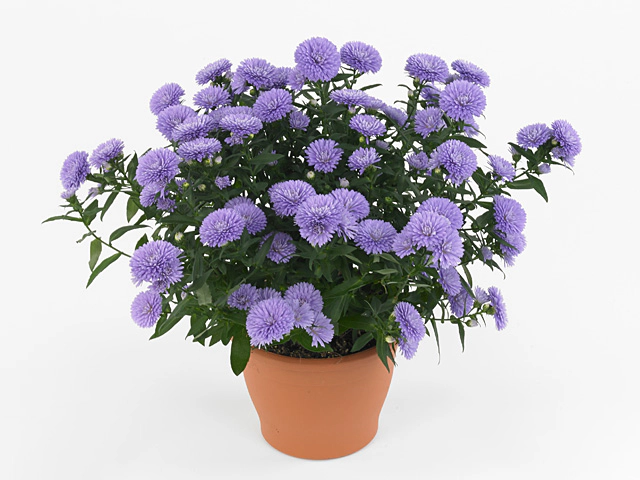
| Leaf tip | Pointed/acute |
| Flower type | Double (pleniflorous) |
| Winter hardness | Good (USDA-zone 5, 6) |
| Flower color | Purple-medium blue violet-N088C |
| Leaf, general shape | Lanceolate |
| Flower diameter | 3 - 3,5 cm |
| Plant height | 20 - 30 cm |
| Inflorescence | Capitulum (head); Raceme |
| Flowering month(s) | July; August; September; October |
| Leaf size | 4 - 5 cm |
| Light conditions | Sunny |
| Leaf, main color | Dark green |
| Flower color distribution | Unicolored |
| Moisture requirements | Moist; Well-drained |
The Aster, also known as the Novi-belgii Grp, Andrea, or Michaelmass Daisy, is a flower that blooms in various shades of purple-medium blue violet. With its double (pleniflorous) flower type and lanceolate-shaped leaves, this plant adds beauty to any garden. It is also a hardy plant, suitable for winter climates in USDA zones 5 and 6.
The Michaelmas Daisy grows to a height of 20 to 30 cm, making it a perfect addition to borders, containers, or as a ground cover. Its inflorescence is in the form of a capitulum or head, with a raceme. The flowers bloom from July to October, brightening up the garden with their vibrant colors.
The Michaelmas Daisy has a flower diameter of 3 to 3.5 cm and a leaf size of 4 to 5 cm. It thrives in sunny conditions, requiring well-drained soil. It is also adaptable to moist conditions.
One of the standout features of the Michaelmas Daisy is its dark green leaves, which provide a beautiful contrast to the colorful flowers. The flower color is distributed uniformly, creating a stunning display when in full bloom.
Gardeners appreciate the versatility and durability of the Michaelmas Daisy. Its compact size makes it suitable for smaller gardens or container planting. It can also be used as a border plant or planted en masse for a striking effect. The Michaelmas Daisy is also a great choice for attracting butterflies and bees into the garden, adding further beauty and life to the space.
In terms of care, the Michaelmas Daisy requires regular watering to keep the soil moist but not waterlogged. Adequate sunlight is crucial for proper growth and flowering. Pruning after blooming can help maintain the plant's shape and encourage new growth. Deadheading spent flowers can also prolong the blooming period.
Overall, the Michaelmas Daisy is a delightful addition to any garden. With its stunning flowers, compact size, and adaptability to various growing conditions, it is a popular choice among gardeners. Whether planted in borders, containers, or as a ground cover, this beautiful and hardy plant is sure to bring joy and color to any outdoor space.
Market availability index by month:
| Jan. | Feb. | Mar. | Apr. | May | Jun. | Jul. | Aug. | Sep. | Oct. | Nov. | Dec. |
|---|---|---|---|---|---|---|---|---|---|---|---|
| - | - | - | - | 1 | 1 | 1 | 3 | 4 | 1 | - | - |